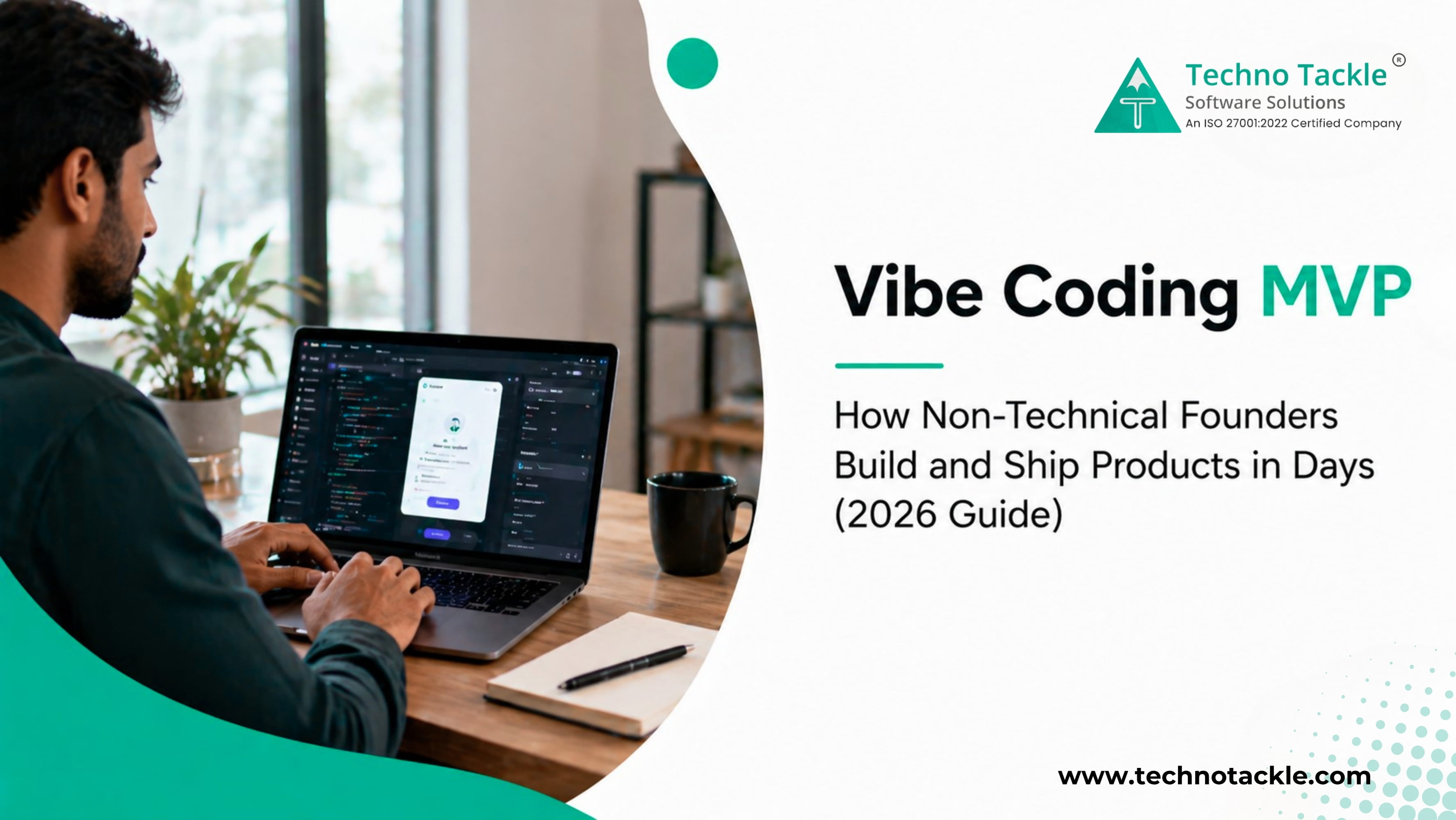
Vibe Coding MVP: How Non-Technical Founders Build and Ship Products in Days (2026 Guide)
Every week, a founder somewhere pays an agency $80,000 to build something nobody wants. Meanwhile, another founder shipped a working prototype in four days, put it in front of real users, got honest feedback, and is already on their second iteration.
The difference is not budget. It is not technical skill. It is the build model.
Vibe coding MVP development has changed what is possible for non-technical founders in 2026. This guide explains exactly what it is, how to use it, which tools work best, and , critically , when to stop using it and bring in real engineering support.
What Is a Vibe Coding MVP?
A vibe coding MVP is a working product prototype built using AI coding tools , where you describe what you want in plain language and the AI writes the code. Instead of hiring a developer or agency, non-technical founders use tools like Replit, Cursor, or Claude Code to go from idea to testable product in 3 to 14 days, at a fraction of traditional development cost.
The term "vibe coding" was coined by Andrej Karpathy, former head of AI at Tesla, in early 2025. His definition is intentionally simple: you give the AI the vibe of what you want to build, and it builds it. No syntax memorisation. No waiting for a sprint to end. No interpreting your vision through someone else's understanding.
For non-technical founders, this removes the single biggest bottleneck in early-stage product development: dependency on someone else's time, schedule, and interpretation.
What Is Vibe Coding? (And Why Founders Are Talking About It in 2026)
Vibe coding is an AI-assisted development approach where natural language prompts , not traditional code , drive product creation. A large language model (LLM) like Claude, GPT-4o, or Gemini translates your description into functional, executable code.
The reason it has captured the startup world in 2026 is timing. Three things converged:
1. AI coding models became genuinely capable. The gap between "AI-generated code" and "production-quality code" narrowed significantly in 2024–2025. For early-stage MVP development , where you need something testable, not something scalable , AI-generated code is now good enough.
2. The tools became accessible to non-developers. Platforms like Replit and Bolt.new abstract away the technical environment entirely. You do not need to set up a server, a database, or a deployment pipeline. You describe the product. The platform handles the infrastructure.
3. Validation became more valuable than polish. Investors, accelerators, and early customers increasingly reward speed over sophistication. A rough prototype in front of real users beats a polished product that launched six months too late.
This is the environment vibe coding for MVP was built for.
How to Ship an MVP Using Vibe Coding , Step by Step
The process that works consistently for non-technical founders follows four stages. Each stage has a specific output. Skip any stage and the quality of the next one suffers.
Stage 1: Define (Day 1)
Write a single paragraph that answers three questions:
-
What does the product do? One core action, not a feature list.
-
Who uses it? Name a specific person, not a demographic.
-
What does success look like at MVP stage? "Someone pays for it" is a valid answer. "Someone uses it" is also valid. "Someone says it's a good idea" is not.
Example of a weak definition: "An app that helps people manage their time better."
Example of a strong definition: "A web app where freelance designers upload their portfolio and get an AI-generated client outreach email tailored to each company they want to approach. Success = a designer sends 10 emails using it in the first week."
The strong definition gives the AI a clear constraint. Constraints produce better output than vague goals, every time.
Stage 2: Build (Days 2–7)
Pick your tool (see the comparison table below). Start with one prompt that describes the core user action , not the full product.
Prompt structure that works:
"Build a [type of app] for [specific user]. The only thing it needs to do is [core action]. Use [stack if you have a preference, or ask the AI to recommend one]. Make it as simple as possible , I want to test the idea, not build the final version."
Then iterate. Each iteration should refine one thing:
-
Prompt 2: Fix what broke or looked wrong in Prompt 1
-
Prompt 3: Add the second most important feature
-
Prompt 4: Make it look presentable enough to show a real person
Do not try to perfect it. Do not add features that are not in your success definition. Do not spend more than seven days on this stage.
Stage 3: Validate (Days 8–14)
Put the prototype in front of 10 to 20 people who match your specific user description. Not friends. Not family. Not people who will be kind to you.
Ask these three questions only:
-
What do you think this does? (Tests clarity)
-
Would you use this? Why or why not? (Tests value)
-
Would you pay X for this? (Tests willingness to pay , name a real number)
Record every answer verbatim. Do not explain the product. Do not defend it. Do not interpret feedback charitably , interpret it accurately.
Stage 4: Decide (Day 14)
Three outcomes are possible:
Strong validation: People understood it, said they'd use it, and at least 30% said they'd pay the price you named. Move to proper engineering. Do not keep building in vibe coding mode once you have real users.
Weak validation: People understood it but wouldn't pay for it, or didn't understand the core value. Identify the one assumption that was wrong and run a second cycle.
No validation: Nobody would pay for it. This is valuable information. Kill this idea or pivot the concept entirely. You spent 14 days and under $1,000 to learn this. Traditional development would have taken 6 months and $50,000 to reach the same conclusion.
Best Vibe Coding Tools for MVP Development in 2026
Not all vibe coding tools are equal. The right choice depends on your technical comfort level, the type of product you are building, and your budget.
Replit
Replit is an excellent choice for non-technical founders who want to build an MVP as quickly as possible. It requires no coding experience, making it highly accessible for beginners. The platform starts at approximately $25 per month and can help you develop a functional MVP in about 3–7 days.
Bolt.new
Bolt.new is best suited for UI-focused applications and users looking for a no-code-friendly development experience. It requires no technical knowledge, making it ideal for entrepreneurs and designers. Bolt.new offers a free tier, and with its rapid development capabilities, an MVP can often be built within 1–5 days.
v0 by Vercel
v0 by Vercel is designed primarily for creating frontend interfaces and UI prototypes. It is perfect for users who need to quickly design and validate product concepts without writing code. The platform offers a free tier, requires no programming experience, and enables developers to create MVP prototypes in as little as 1–3 days.
Cursor
Cursor is best suited for technical founders and developers who want greater flexibility and control over their applications. While it doesn't require advanced expertise, having basic coding knowledge is beneficial. Priced at around $20 per month, Cursor enables developers to build MVPs in approximately 3–5 days, making it a strong choice for custom software development.
Claude Code
Claude Code is ideal for complex applications involving advanced logic and multi-file projects. It is intended for developers who are comfortable with the command-line interface (CLI) and more technical workflows. Instead of a fixed monthly fee, it uses a usage-based pricing model. Depending on the complexity of the project, an MVP can typically be completed within 5–14 days.
For pure non-technical founders: Start with Replit or Bolt.new. Both have in-built environments , you do not manage servers, packages, or deployments. The AI handles the full stack.
For founders with some technical background: Cursor gives you more control over the generated code and integrates with your existing development environment.
For complex multi-feature products: Claude Code handles larger codebases and more nuanced architectural decisions, but requires basic command line familiarity.
Claude.md Starter Template for Solo Founders
One of the most effective ways to start a vibe coding MVP session with Claude Code or Claude in any interface is with a structured claude.md prompt. This file sits in your project root and tells Claude the context of your entire project every time you start a session.
Copy this template and adapt it to your product:
# Project: [Your Product Name]
## What this product does
[One sentence: core action, for whom, producing what outcome]
## Target user
[Specific description: their job, their problem, what they already tried]
## MVP definition
The MVP must do exactly one thing: [core user action]
Nothing else is in scope for this iteration.
## Technical constraints
- Keep the stack as simple as possible
- Use [React/plain HTML/whatever you prefer] for the frontend
- Use [Supabase/Firebase/SQLite] for data , or ask me to choose
- No authentication complexity unless the core action requires it
## Success criteria
A real user completes [core action] without me explaining how it works.
## What I do NOT want
- Feature suggestions outside the MVP scope
- Complex architecture
- Production-level security hardening (I'll do that later)
- Explanations of what you're doing , just build it
This template removes ambiguity from every prompt. Claude knows the project context, the constraints, and the scope. Each session starts with alignment instead of re-explanation. Founders who use this structure consistently report 40–60% fewer revision cycles in their first week of vibe coding.
Vibe Coding MVP for Non-Technical Founders: What You Can and Cannot Build
Vibe coding for MVP is powerful within a specific range. Understanding that range before you start prevents wasted weeks and misplaced expectations.
What works well
-
Landing pages with lead capture , email list, waitlist, or consultation booking
-
Internal dashboards and reporting tools , data visualisation, operational views
-
Booking and scheduling tools , calendar-based workflows, appointment systems
-
Prototype SaaS apps , basic create/read/update/delete functionality
-
Customer-facing forms and intake workflows , multi-step data collection
-
Simple e-commerce storefronts , product display, basic checkout with Stripe
-
Data collection and visualisation tools , survey tools, reporting dashboards
-
Directory or marketplace MVPs , listing-based products with search and filter
-
AI-powered tools , chatbots, content generators, summarisation tools
What does not work well
-
High-security financial or medical applications , requires compliance-level review
-
Distributed systems with complex architecture , vibe coding produces monoliths
-
Real-time low-latency applications , multiplayer, live video, trading systems
-
Regulatory-compliant software , HIPAA, PCI-DSS, SOC 2 require engineering sign-off
-
Mobile-native applications , web apps built with vibe coding do not translate well to native iOS or Android performance requirements
The honest boundary: vibe coding for MVP handles the 80–90% of validation work you need to do before committing to serious engineering investment. Treat it as a validation tool, not a production tool.
Vibe Coding MVP Costs vs Traditional MVP Development
The cost difference between vibe coding and traditional MVP development is not marginal. It is structural.
Cost Range
Vibe Coding significantly reduces the cost of MVP development, with projects typically ranging between $500 and $5,000. This makes it an attractive option for startups and entrepreneurs with limited budgets. In contrast, traditional MVP development generally costs between $30,000 and $500,000, depending on the project's complexity, development team, and timeline.
Time to Prototype
One of the biggest advantages of Vibe Coding is speed. A working MVP can often be developed within 3 to 14 days, allowing founders to validate ideas quickly. Traditional MVP development usually requires 3 to 9 months, as it involves extensive planning, design, development, testing, and project management.
Control Over Product Direction
With Vibe Coding, you maintain complete control over your product's direction. Changes can be made instantly by refining prompts and iterating with AI tools. In traditional MVP development, product decisions are often shared with developers or agencies, requiring discussions, approvals, and additional coordination before changes are implemented.
Ease of Pivoting
Vibe Coding makes it easy to pivot when new ideas or customer feedback emerge. Adjustments can often be made simply by updating prompts or modifying AI-generated code. Traditional development, however, usually requires renegotiating the project scope, timeline, and budget, making pivots more time-consuming and expensive.
Code Quality
The code generated through Vibe Coding is generally functional and suitable for building prototypes or validating ideas, but it may require additional optimization before it is ready for large-scale production. In traditional MVP development, code quality largely depends on the expertise and practices of the agency or development team, which can vary significantly.
Iterations Before Launch
Vibe Coding enables multiple rapid iterations before launching a product, allowing founders to test, refine, and improve features in a short period. Traditional development often limits the number of iterations because each revision consumes additional development time and budget, making the overall process slower.
Risk if the Idea Fails
If an idea does not succeed, Vibe Coding minimizes financial and time-related risks. Founders typically invest only a few days of effort and less than $5,000, making experimentation more affordable. In contrast, a failed traditional MVP can result in months of development work and investments that may exceed $100,000, creating a much higher financial risk.
A specific example from the startup ecosystem: a solopreneur was quoted over $500,000 by a development agency for a custom application. Using Replit's AI tools, they built a working version for under $1,000. That prototype went on to raise a seed round.
This is not an edge case anymore. For early-stage validation, vibe coding has fundamentally changed the economics of startup product development.
Real Risks of Vibe Coding for MVP (What Most Blogs Do Not Tell You)
Most content about vibe coding focuses on the wins. The risks are just as real, and ignoring them will cost you later.
Code quality is unpredictable
AI-generated code is often not structured for scale. Functions are duplicated. Variable naming is inconsistent. Edge cases are skipped. If your MVP gets traction and you need to build on that code, you may find it fragile or costly to extend.
What to do: When you are ready to scale, have an experienced developer review the vibe-coded codebase before building on it. In many cases, a partial rewrite is faster than extending poorly structured code.
Security vulnerabilities are common
Code generated by AI tools frequently skips proper security reviews. Input validation, SQL injection protection, authentication edge cases , these are not priorities for a model optimised for "make it work quickly."
What to do: Before you collect any real user data , email addresses, payment information, health data , have a qualified developer audit the code for security. This is not optional. It is a legal and ethical requirement.
Debugging is harder than it looks
AI writes code you did not author. When something breaks, understanding why requires more context than debugging your own work. The AI may suggest fixes that introduce new problems, creating a spiral of patches on top of patches.
What to do: Set a debugging time limit. If a problem takes more than two hours to fix through prompting, it is a sign the underlying code structure needs rebuilding, not patching.
Technical debt compounds fast
As you add features through prompts, the codebase becomes inconsistent. Different sections use different patterns. Data is handled differently in different places. Long-term, this creates technical debt that costs more to fix than building properly from the start would have.
What to do: Treat your vibe-coded MVP as disposable. Its purpose is to validate demand. Once demand is validated, plan to rebuild on a proper foundation , not to extend the prototype indefinitely.
When to Use Vibe Coding vs When to Hire a Developer
This decision matters more than which vibe coding tool you choose. Getting it wrong in either direction is expensive. How to integrate developers into your team after vibe coding:
Use vibe coding for MVP when:
-
You have not yet validated that people will pay for this idea
-
You are testing a specific feature, workflow, or assumption
-
You need something visual to show investors or early users within two weeks
-
Your budget is under $10,000 for the validation phase
-
Speed of learning matters more than quality of output
Bring in a developer or technical partner when:
-
You have validated demand and real users are using the product
-
Security, compliance, or sensitive data handling is required
-
You need real-time features, complex third-party integrations, or mobile-native performance
-
You have raised funding and need to build fast with production quality
-
The vibe-coded codebase has become too unstable to extend reliably
The most common mistake is staying in vibe coding mode too long after real users arrive. A rough prototype is acceptable for validation. It is not acceptable as the foundation for a product that real users depend on.
What Happens After You Validate Your MVP With Vibe Coding?
choosing your next step after MVP validation
Validation is the easy part. What comes next is where most founders stall.
You have a working prototype. Users are responding positively. Some are paying. Now you face the questions that vibe coding cannot answer: How do you harden the code for production? How do you add features that are beyond what AI tools can generate reliably? How do you scale without rewriting everything from scratch?
This is exactly the transition TechnoTackle is built for.
TechnoTackle works with early-stage founders who have used vibe coding to validate their idea and now need a technical partner to take it further. Instead of starting from scratch, the team reviews your AI-generated codebase, identifies what can be kept and what needs to be rebuilt, and creates a clear roadmap to production , without the six- month timeline and $200,000 budget of a traditional agency engagement.
This is not outsourcing. You stay in control of product decisions. TechnoTackle handles the engineering execution.
If your prototype is getting traction and you need to build it properly, [talk to the TechnoTackle team →] before you hire a full-time engineer or sign an agency contract. You may save six months and a significant amount of money.
A Practical 3-Week Framework to Build and Validate an MVP With Vibe Coding
For founders who want a structured process rather than an open-ended build cycle:
Week 1: Define and Build
-
Write a one-paragraph product definition (use the format from Stage 1 above)
-
Set up your claude.md file using the template above
-
Choose your vibe coding tool based on the comparison table
-
Generate your first working version using 3–5 iterative prompts
-
Do not try to make it perfect , make it functional and testable
End of week 1 output: A working prototype that demonstrates the core user action.
Week 2: Test and Validate
-
Identify 10–20 people who match your exact target user description
-
Put the prototype in front of them , do not explain it first
-
Ask the three validation questions (clarity, value, willingness to pay)
-
Record every response verbatim without interpretation
-
Do not add features during this week , only observe and record
End of week 2 output: A clear answer to whether people will pay for this.
Week 3: Decide and Plan
-
If validation is strong: document everything you learned, get a codebase review, and begin planning your production engineering phase
-
If validation is mixed: identify the single assumption that failed and run one more cycle focused on that assumption
-
If validation is absent: decide whether to pivot the concept or move on to a new idea
End of week 3 output: A clear decision and a defined next step.
TechnoTackle offers a structured consultation for founders completing this process. If your prototype is gaining traction, their team can review your codebase and give you an honest assessment of what it will take to build it properly. [Book a consultation →] find a technical partner to scale your validated MVP
Frequently Asked Questions
What is a vibe coding MVP? A vibe coding MVP is a working product prototype built using AI coding tools where you describe what you want in plain language and the AI generates functional code. Instead of hiring a developer, non-technical founders use tools like Replit, Cursor, or Claude Code to go from idea to testable product in 3 to 14 days at a fraction of traditional cost.
How do you ship an MVP using vibe coding? Define your product in one paragraph, choose a vibe coding tool (Replit for beginners, Cursor for technical users), generate your first working version with 3–5 iterative prompts, and put it in front of 10–20 real users within two weeks. The goal is to test one core assumption , not to build a polished product.
What is the best vibe coding tool for non-technical founders? Replit and Bolt.new are the most accessible starting points for founders with no development background. Both provide a complete environment with no server setup. Replit is best for web apps with a back-end; Bolt.new is best for UI-heavy or frontend-first products.
How much does it cost to build an MVP with vibe coding? Most vibe coding tools cost between $20 and $100 per month for the plan you need. Total cost for a working prototype , including tool subscription and any AI API usage , typically falls between $500 and $5,000. Traditional MVP development for the equivalent product ranges from $30,000 to $500,000.
Is vibe coding safe for building real products? Vibe coding is well-suited for early-stage prototypes and validation tools. It is not safe for production systems handling sensitive data, financial transactions, or regulated industries without a qualified developer reviewing and hardening the generated code.
When should I stop using vibe coding and hire a real developer? Stop using vibe coding as your primary build tool when: you have validated real demand and users are paying; security or compliance is required; or the codebase has become too unstable to extend reliably. At this stage, bring in a technical partner to review the prototype and plan the production build. mobile app development options for founders moving beyond their MVP
What can you build with vibe coding for an MVP? Vibe coding works well for landing pages, internal dashboards, booking tools, SaaS prototypes with basic functionality, customer-facing forms, simple e-commerce, data collection tools, directories, and AI-powered features. It does not work well for real-time systems, mobile-native apps, or anything requiring compliance out of the box.
What is a claude.md file and how does it help vibe coding? A claude.md file is a project context document that sits in your project folder and gives Claude (or another AI tool) consistent context about your product, constraints, and goals at the start of every session. Using a structured claude.md file reduces revision cycles, keeps the AI focused on the right scope, and prevents the AI from suggesting features or complexity outside your MVP definition.